
What Happens After We Become AI Fluent?
Turning people capability into new ways of working—and enterprise value

AI fluency is quickly becoming an important enterprise priority.
Organizations are investing in AI tools, copilots, agents, training, and experimentation. Employees are learning how to use AI for research, analysis, communication, software development, customer engagement, and many other aspects of their work.
This is important progress.
As AI becomes part of everyday work, people need to understand what it can do, how to use it effectively, how to evaluate its output, and where human judgment remains essential.
But as I have been thinking about AI fluency and what it means for organizations, I keep coming back to a simple question:
What happens after we become AI fluent?
If we teach people how to use AI, give them access to increasingly capable tools, and then send them back into exactly the same processes, workflows, and ways of working, have we captured the real opportunity?
I don't think fluency alone is enough.
The larger opportunity is what happens when AI-fluent people begin applying that capability to rethink their work.
That is where fluency can become transformation.
And that is the journey I believe enterprises should increasingly consider:
AI Fluency → Application → Work Redesign → Enterprise Change → Value
AI Transformation Starts with People
There is a tendency to think about AI transformation primarily through technology.
Which models should we use?
Which platform should we adopt?
Where should we deploy copilots?
What agents should we build?
Those are important questions.
But technology alone does not redesign work.
People do.
People understand the context of their work. They know where friction exists. They experience repetitive processes, unnecessary handoffs, information gaps, slow decisions, and activities that consume time without necessarily creating value.
AI fluency gives those people something important: a new lens through which to look at their own work.
Once someone understands what AI can do, different questions become possible:
Why do I spend time doing this?
Could AI help me do it better?
Does a person still need to perform this activity?
Could an agent perform part of it?
Could the activity disappear altogether?
Where does my experience and judgment create the greatest value?
That is why I believe AI fluency should be viewed as more than a workforce-development initiative.
It can become an enterprise transformation capability.
Fluency Should Lead to Application
AI fluency is not simply knowing how to prompt an AI system.
For me, it means developing enough understanding, confidence, curiosity, and judgment to recognize where AI can—and cannot—create value.
And that capability develops through practice.
I have found a simple cycle useful:
Learn → Experiment → Apply → Share
Learn what is possible.
Experiment against real problems.
Apply what works.
Share what you learn so others can build on it.
This is important because organizations can easily fall into the trap of measuring AI fluency through activity:
How many employees completed training?
How many licenses have been activated?
How many people are using AI each week?
How many prompts are being generated?
Those metrics tell us something about adoption.
But the more meaningful question is:
What are people doing differently because they became AI fluent?
That is the bridge between fluency and value.
From Productivity to Work Redesign
The first benefits of AI are often personal and immediate.
A research task that previously required several hours may take much less time.
A document can be prepared faster.
Information can be synthesized more effectively.
A customer meeting can be prepared for more thoroughly.
Software development can accelerate.
These productivity gains matter.
Across a large organization, even modest improvements multiplied across thousands of people can create significant capacity.
But there is also a limitation.
We may still be doing essentially the same work, through the same processes, only faster.
That is where I believe the next opportunity begins.
Consider something as familiar as a contract-review process.
The first use of AI may be to summarize a contract, identify clauses, or help an expert complete the review faster.
That is valuable.
But an AI-fluent team may begin asking a different set of questions.
Could AI extract the relevant terms automatically?
Could those terms be compared with approved standards?
Could routine agreements move through the process differently from exceptions?
Could an intelligent system identify deviations and route only material issues to an expert?
Could information captured during contracting become structured intelligence available for future decisions?
Now the conversation has changed.
We are no longer simply making contract review faster. We are reconsidering how contract review should work.
The human role also changes—from processing every activity toward applying expertise and judgment where those capabilities matter most.
This distinction is important:
AI productivity makes existing work faster. AI-enabled work redesign asks whether we should still be doing the work the same way at all.
The AI Value Gap
This brings us to a challenge I believe many leadership teams will increasingly encounter.
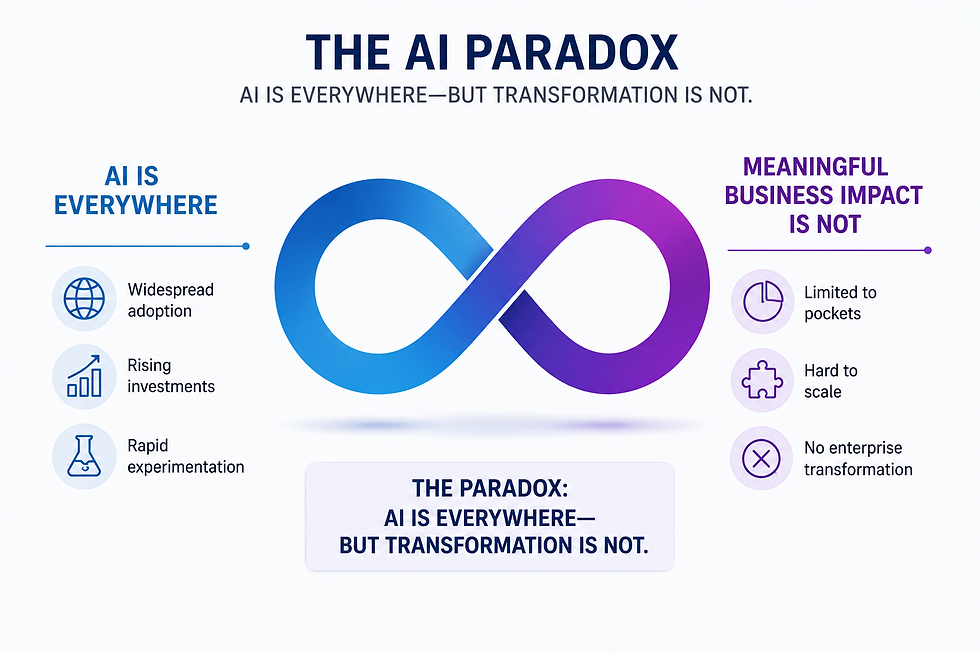
Organizations can make significant investments in AI fluency and adoption without necessarily seeing an equivalent level of enterprise value.
Recent research reinforces this point.
McKinsey's 2025 global AI survey found that 88% of respondents reported regular AI use in at least one business function. Yet only about one-third said their organizations had begun scaling AI across the enterprise, and only 39% reported any enterprise-level EBIT impact attributable to AI.
Perhaps even more relevant to this discussion, McKinsey found that among the organizational practices it studied, redesigning workflows had the greatest effect on an organization's ability to see EBIT impact from generative AI.
That distinction matters.
Organizations may increasingly succeed at the left side of the equation:
AI Access → AI Training → AI Fluency → AI Adoption
But measurable value depends on what happens next:
Application → Work Redesign → Operating Change → Business Outcomes
I think of the distance between these two as the AI Value Gap.
The AI Value Gap is the distance between building AI capability in people and translating that capability into different ways of working and measurable enterprise value.
Closing that gap is not primarily a training challenge.
It is an application and transformation challenge.
A Different Way to Think About the Journey
Rather than thinking about AI transformation primarily as a technology maturity curve, I find it useful to look at it through the relationship between people, work, and value.
1. AI Fluency
Build people's capability

People understand AI well enough to use it confidently, responsibly, and critically.
The outcome is not expertise in AI technology.
The outcome is the ability to recognize possibilities.
↓
2. AI Application
Apply that capability to real work
People experiment with actual business problems.
They discover where AI creates value, where it does not, and where human expertise remains essential.
The outcome is not more experimentation.
The outcome is useful application.
↓
3. Work Redesign
Change how work gets done
Teams stop looking only at individual tasks and begin reconsidering entire workflows.
Activities may be augmented, automated, eliminated, combined, or redesigned.
The outcome is not maximum automation.
The outcome is better work.
↓
4. Enterprise Change
Change how people and AI work together
As workflows change, roles, organizational capacity, technology architecture, management practices, and operating models may begin changing with them.
The outcome is not an "AI organization."
The outcome is a more effective organization enabled by people and AI working together.
↓
5. Enterprise Value
Create measurable impact
Ultimately, the transformation must show up in outcomes:
Productivity.
Speed.
Quality.
Scale.
Customer experience.
Innovation.Growth.
That is where AI fluency becomes enterprise value.
People Are Not Simply the First Step
There is an important nuance here.
People should not be viewed simply as the first box in an AI transformation model—something organizations "complete" before moving on to technology and processes.
People remain central throughout the journey.
They identify opportunities.
They redesign workflows.
They determine where judgment is required.
They establish appropriate boundaries for AI.
They learn from what works and what does not.
And they continually improve the system.
This becomes particularly important as AI capabilities expand.
PwC's 2026 Global AI Jobs Barometer found that productivity growth was 40% higher at companies most exposed to AI than at those least exposed. At the same time, it found that skills in highly AI-exposed jobs are changing more than twice as fast, and that AI-exposed junior roles are increasingly requiring capabilities traditionally associated with more senior work.
That suggests an interesting possibility.
AI may automate or augment portions of work while simultaneously increasing the importance of distinctly human capabilities such as:
Judgment.
Leadership.
Creativity.
Relationships.
Problem solving.
Accountability.
The goal therefore should not simply be to remove people from processes.
It should be to reconsider where people create the greatest value.
What Does This Mean for the Way We Work?
As people become more fluent and begin redesigning work, a useful question is how activities should be distributed.
I see four broad possibilities.
Human-Led
Work where judgment, relationships, creativity, negotiation, empathy, strategic context, or accountability are central.
AI-Assisted
Work where AI improves human speed, insight, quality, or decision-making.
Agent-Executed
Repeatable work that intelligent systems can perform within clearly defined boundaries.
Human-Governed
Work that AI can perform but where people retain oversight, approval, or accountability.
The objective should not be to move as much work as possible from the first category to the third.
The objective is to find:
The right combination of human expertise and AI capability for the outcome we are trying to achieve.
That is a very different objective from automation alone.
When Work Changes, the Operating Model May Follow
If enough workflows change, eventually the organization itself begins to feel different.
Organizations have traditionally thought about capacity primarily in terms of people.
How much work do we have?
How many people do we need?
How should we organize them?
But future teams may increasingly operate through a combination of:
People + AI Assistants + Specialized Agents + Data + Automated Workflows
Microsoft's 2025 Work Trend Index found that 82% of leaders viewed the year as pivotal for rethinking key aspects of strategy and operations, while 81% expected agents to become moderately or extensively integrated into their AI strategy within the following 12–18 months.
If that direction continues, some practical organizational questions follow.
Who owns an agent?
How should its performance be measured?
Where does accountability reside?
How should roles evolve?
What should managers manage when some capacity comes from intelligent systems?
How do we think about scale when output can increase without resources increasing proportionally?
We don't yet have complete answers to these questions.
But AI-fluent organizations should be better positioned to begin answering them because their people understand both the work and the emerging capability.
Technology Must Support the New Way of Working
Work redesign also changes how we think about enterprise technology.
For decades, organizations have invested heavily in systems of record.
CRM manages customer information.
ERP manages transactions.
PLM manages product information.
Other enterprise systems manage employees, suppliers, assets, contracts, and operations.
Those systems remain essential.
But AI potentially adds another layer:
Systems of Record → Data & Context → Intelligence → Agents → Actions
Enterprise technology may increasingly not only store and present information.
It may interpret information, recommend actions, initiate workflows, coordinate activities, and—in appropriately governed situations—act.
But technology architecture should follow the work we are trying to enable.
Otherwise, we risk building sophisticated AI capabilities around processes that should have been reconsidered in the first place.
The Same Thinking Applies to Products
The people → application → redesign principle also extends beyond internal operations.
It applies to the products we build.
Consider enterprise software.
The first generation of AI frequently adds a copilot alongside an existing application.
That can create meaningful value.
But imagine an existing workflow that requires a customer to navigate ten screens, gather information from several systems, make selections, and initiate a process.
AI could help the user navigate those ten screens more efficiently.
Or product teams could ask:
Why does the customer still need to navigate ten screens?
Could an intelligent system understand the desired outcome?
Could it gather the relevant context?
Could it recommend an action?
Could it execute approved steps?
Could it involve the customer only when judgment or a decision is required?
At that point, the product-management question changes from:
Where should we add AI?
to:
What should the user still need to do?
That is work redesign applied to product strategy.
And It May Extend Across Ecosystems
The same thinking may eventually extend beyond the boundaries of one enterprise.
No company possesses every application, data source, model, domain capability, and specialized form of intelligence its customers require.
Today's technology ecosystems connect applications through APIs, integrations, marketplaces, and developer platforms.
Tomorrow's ecosystems may increasingly connect:
Applications + Agents + Models + Data + Domain Intelligence + Actions
Imagine an industrial ecosystem where one participant contributes engineering intelligence, another equipment expertise, another operational data, and specialized agents help coordinate those capabilities around a customer's desired outcome.
The ecosystem is no longer simply exchanging information between applications.
It may begin coordinating intelligence and action across organizational boundaries.
That could make ecosystems more important in the AI era, not less.
The Leadership Question Is Not Simply "What Is Our AI Strategy?"
There is understandable pressure on leadership teams to define an AI strategy.
But I wonder whether the more useful questions are becoming more practical.
Are our people becoming genuinely AI fluent?
Are they applying that fluency to real work?
Are we creating the space for them to question existing processes?
Which workflows should we rethink rather than simply automate?
Where can AI augment human expertise?
Where could agents create additional capacity?
Where must human judgment remain central?
What needs to change in our operating model as a result?
And perhaps the most important question:
If our people designed this work today, knowing the capabilities now available to them, would they design it the same way?
That question moves AI from a technology discussion to a people and enterprise transformation discussion.
AI Fluency Is the Beginning
I believe the journey can be summarized simply:
PEOPLE
AI Fluency
Build capability
↓
APPLICATION
Apply AI to Real Work
Turn knowledge into action
↓
WORK
Rethink How Work Gets Done
Augment • Automate • Eliminate • Redesign
↓
ENTERPRISE
Change How We Operate
People + AI + Agents + Workflows
↓
VALUE
Create Measurable Impact
Productivity • Speed • Scale • Innovation • Growth
The technology is clearly important.
But the transformation ultimately moves through people.
Fluency gives people the ability to see new possibilities.
Application turns those possibilities into experience.
Experience allows teams to redesign work.
Redesigned work begins changing how the enterprise operates.
And those changes can ultimately create measurable value.
Organizations will move through this journey differently. Not every process needs AI. Not every activity should be automated. And becoming "AI-native" should not become another label organizations pursue for its own sake.
The objective is not to create more AI.
The objective is to create better ways of working and better outcomes because AI now makes them possible.
That is why I believe AI fluency matters so much.
But it is also why fluency cannot be the end goal.
AI fluency gets people ready for AI. The larger opportunity is enabling those people to rethink how work gets done—and, through that, how the enterprise creates value.


Comments