
From APIs to AI to MCP: Building the Next-Generation Platform Business
APIs expose capability, AI drives action, MCP controls execution, Ecosystem scale value

Over the past decade, APIs helped companies move from closed products to open platforms. That shift enabled integration, partner ecosystems, and new distribution models.
Today, a second shift is happening—driven by AI.
And now, a third layer is emerging on top of both: the MCP (Model Context / Control / Connectivity Protocol) layer.
Together, APIs, AI, and MCP are not just reshaping technology—they are redefining how businesses operate, scale, and monetize.
In this new model:
APIs expose what a business can do
AI determines what should be done
MCP governs how it gets done at scale
The companies that align these three layers effectively will move beyond building products or even platforms—they will operate programmable, autonomous business systems that continuously generate value through ecosystems and intelligent execution.
1. The Shift: From Products to Programmable Businesses
For a long time, growth was driven by building better products—more features, better performance, stronger differentiation. Then platforms emerged, allowing companies to extend their reach by enabling others to build on top of them. APIs were the foundation of that shift.
But that model is now evolving again.
Today, value is no longer created only by what a company builds internally. It is increasingly created by how well a company enables others—developers, partners, and now AI systems—to build, integrate, and execute using its capabilities.
This is where the concept of a programmable business comes in.
A programmable business is one where:
Capabilities are modular and exposed
Execution is dynamic and automated
Value is created through continuous interaction between systems
This is not just about efficiency. It is about fundamentally changing how growth happens—from linear to compounding.
2. Reframing API Strategy: From Integration to Business Design
Most organizations still think about APIs as technical tools—interfaces that allow systems to talk to each other. That view is outdated.
In today’s environment, API strategy is about business design.
When you expose an API, you are not just enabling integration—you are defining:
What capabilities others can access
How those capabilities are consumed
Whether and how they generate revenue
This is why leading companies treat APIs as products. They invest in developer experience, documentation, lifecycle management, and pricing strategies—not because it is technically necessary, but because it is commercially critical.
The difference between average and leading organizations is not whether they have APIs. It is whether those APIs are:
Aligned to meaningful business capabilities
Designed for real-world workflows
Connected to monetization models
When done right, APIs turn internal capabilities into external growth engines.
3. The Role of AI: From Insight to Execution
AI has introduced a new dynamic into this system.
Initially, AI was used to generate insights—recommendations, predictions, analytics. But insights alone do not create value unless they lead to action.
What is changing now is that AI is moving from analysis to execution.
Modern AI systems, especially those built on large language models, are capable of:
Understanding intent
Breaking down tasks
Orchestrating actions
But they cannot execute those actions on their own. They depend on APIs to interact with systems, trigger workflows, and complete tasks.
This is where the relationship between AI and APIs becomes critical.
APIs effectively become the “hands” of AI. They are how decisions turn into outcomes.
This has two major implications:
The quality and structure of your APIs directly determine what AI can do
AI dramatically increases the demand for API consumption
In other words, APIs create supply, and AI creates demand.
4. Introducing MCP: The Missing Control Layer
As organizations begin to connect AI systems with APIs at scale, a new challenge emerges: orchestration.
Without a standard layer to manage how AI interacts with APIs, every integration becomes custom, fragile, and difficult to scale. This is where the MCP layer comes in.
MCP can be understood as the control and coordination layer between AI and APIs.
It provides:
A structured way for AI to discover available capabilities
A consistent method for invoking APIs
Context management to ensure relevance and accuracy
Governance to enforce security, compliance, and control
If APIs enabled platforms, MCP enables AI-native platforms.
It becomes the layer that ensures AI-driven execution is not only possible, but reliable, secure, and scalable.
Strategically, this is significant because control points in architecture often become control points in business. Just as operating systems and cloud platforms became powerful economic layers, MCP has the potential to become the next such layer in the AI era.
5. The Integrated Architecture: How It All Works Together
To understand the full picture, it helps to look at the system as a set of connected layers.
At the top is the experience layer, where users, applications, and AI assistants interact with the system. This is where intent originates.
Below that sits the AI layer, where models interpret intent and determine what actions need to be taken.
The MCP layer sits beneath AI, acting as the control plane. It translates intent into structured actions, manages context, and ensures that execution is governed appropriately.
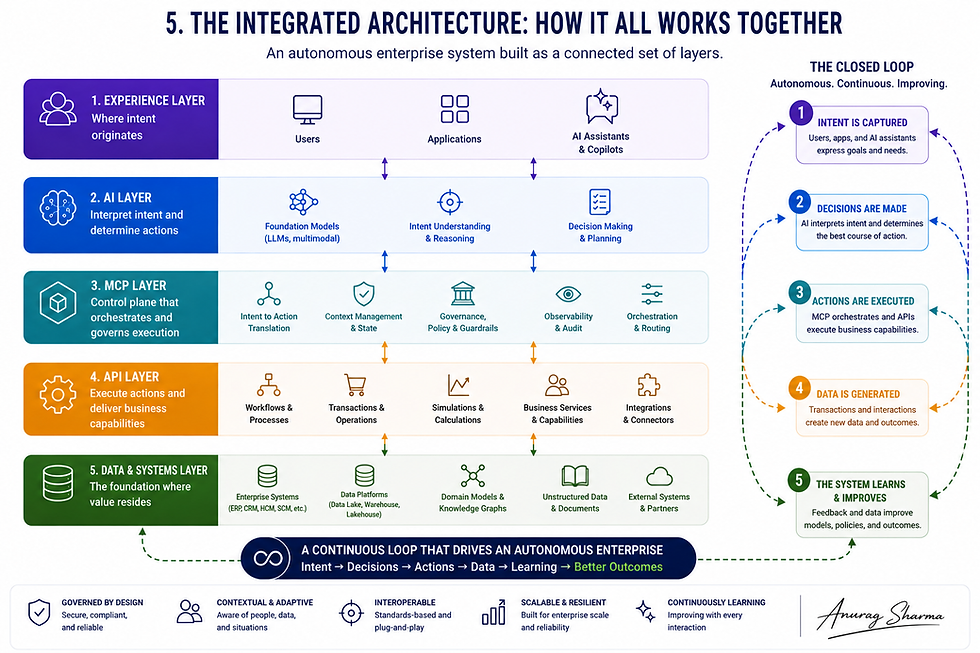
The API layer is where those actions are executed. This is where business capabilities—such as workflows, transactions, and simulations—are actually performed.
Finally, at the foundation is the data and systems layer, where the underlying value resides in enterprise systems, data platforms, and domain models.
Together, these layers form a closed loop:
Intent is captured
Decisions are made
Actions are executed
Data is generated
The system learns and improves
This loop is the basis of what can be described as an autonomous enterprise system.
6. From Architecture to Business: The Flywheel Effect
When APIs, AI, and MCP are aligned, they create more than a system—they create a flywheel.
APIs expose capabilities
AI increases their usage
MCP standardizes and scales execution
Ecosystems expand the range of solutions
Monetization captures the value created
As this loop continues, each part reinforces the others.
More APIs lead to more use cases. More AI-driven consumption leads to more data and insights. More ecosystem participation leads to more innovation. And all of it feeds into increased revenue and further investment.
This is fundamentally different from traditional growth models. Instead of building, selling, and repeating, companies create systems that continuously generate and amplify value.
7. Monetization: From Access to Outcomes
One of the most important—and often overlooked—implications of this model is how monetization changes.
In traditional software models, revenue is tied to licenses or subscriptions. In API-driven models, revenue often shifts to usage-based pricing. But with AI and MCP, even that is evolving further.
Organizations now have the opportunity to monetize not just access or usage, but outcomes.
For example, instead of charging per API call, a company might charge for:
A completed workflow
An optimized plan
A successful transaction
AI enables this because it can orchestrate multiple steps into a single, measurable outcome. MCP enables it by standardizing how those steps are executed and governed.
At the same time, ecosystems introduce additional monetization layers, such as:
Revenue sharing with partners
Marketplace transactions
Embedded or OEM licensing
The result is a multi-dimensional monetization model that is far more scalable and aligned to value creation.
8. Industry Implications: Where Differentiation Will Come From
As more companies adopt APIs and AI, simply having these capabilities will no longer be differentiating.
The real differentiation will come from:
How deeply business capabilities are exposed and structured
How effectively AI can leverage those capabilities
How well MCP enables scalable, governed execution
How successfully ecosystems are activated
How clearly monetization is tied to value
Companies that treat APIs as technical artifacts, AI as isolated features, or monetization as an afterthought will struggle to realize the full potential of this model.
Those that integrate all three—API, AI, and MCP—into a cohesive strategy will define the next generation of platform businesses.
9. What Leading Companies Are Demonstrating
We can already see elements of this model in action.
Companies like Amazon built internal API-driven architectures that evolved into Amazon Web Services, creating entirely new business lines and redefining cloud infrastructure as a programmable platform.
Stripe demonstrated how APIs themselves can become the product, where simplicity, developer experience, and embedded monetization created massive ecosystem adoption.
Salesforce showed how APIs can evolve into ecosystem growth engines through platforms like AppExchange, enabling partners and ISVs to extend the core platform with industry-specific solutions.
More recently, OpenAI has demonstrated how AI systems can orchestrate tools and APIs dynamically through function calling and agent workflows—an early signal of MCP-like orchestration models emerging in practice.
At the enterprise layer, Microsoft is building toward an MCP-style control plane through Microsoft Copilot, Microsoft Graph, plugins, and AI orchestration capabilities that connect enterprise data, workflows, and applications into a unified intelligent execution environment.
Similarly, Google is combining AI models, tool orchestration, and cloud-native APIs through Vertex AI and agent frameworks to create a scalable AI interaction layer across enterprise systems and developer ecosystems.
Anthropic is also shaping this direction with structured tool-use frameworks and governed AI execution models that emphasize safety, context, and trusted orchestration between AI systems and external capabilities.
Meanwhile, Snowflake is integrating data platforms, APIs, AI workloads, and marketplaces into a unified ecosystem model where data, intelligence, and applications become composable business assets.
Each of these examples highlights a different part of the same evolution—and together they point toward a converging model.
10. Final Perspective: Owning the Next Platform Layer
We are entering a phase where the question is no longer whether to adopt APIs or AI.
The question is:
Who will own the control layer that connects them?
Because that layer—MCP—will determine:
How capabilities are discovered
How workflows are executed
How value is captured
In previous waves, value accrued to those who owned platforms and ecosystems. In this wave, value will increasingly accrue to those who own the orchestration layer of intelligent execution.
Closing Thought
The progression is clear:
Products expose value.
Platforms scale value.
Ecosystems multiply value.
Autonomous systems continuously create value.
And at the center of that transformation:
APIs define capability
AI drives action
MCP controls execution
Together, they form the foundation of the next-generation digital enterprise.


Comments