
From AI Excitement to Enterprise Value
Why Most AI Initiatives Stall—and How to Turn Them into a Scalable Business Advantage
Executive Summary
Artificial Intelligence has moved from experimentation to executive priority at an unprecedented pace. Breakthroughs from organizations such as OpenAI and Google DeepMind have redefined what software can do—from automating tasks to generating insights and supporting decisions.
The scale of the opportunity is significant. McKinsey & Company estimates that generative AI could contribute between $2.6 trillion and $4.4 trillion annually to the global economy. Gartner projects that by 2026, the majority of enterprises will have integrated generative AI into their operations.
Yet, despite this momentum, a fundamental gap persists.
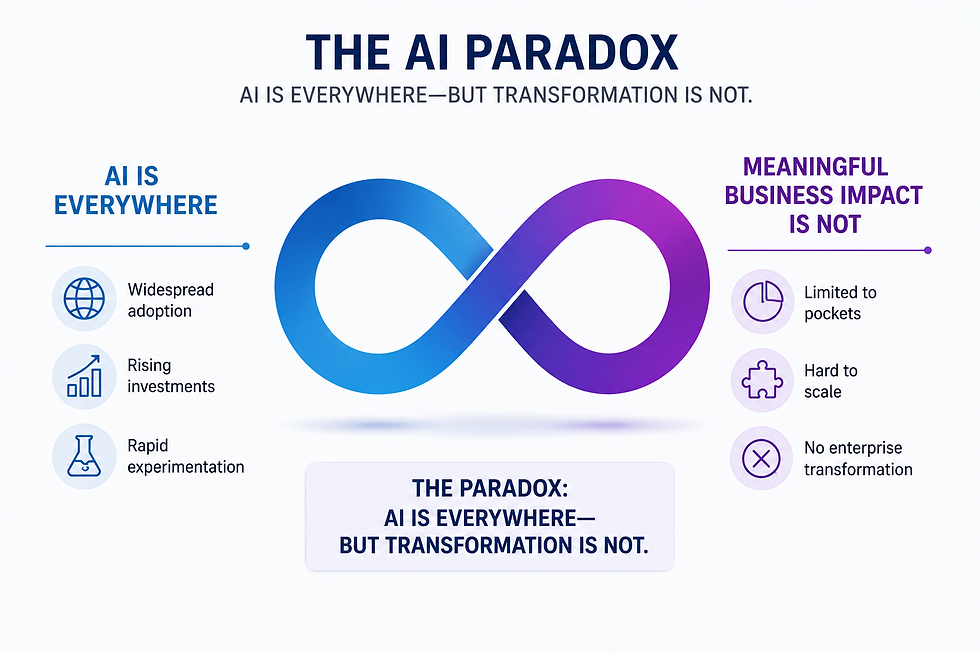
AI is widely adopted, investments are accelerating, and experimentation is everywhere—but enterprise-scale impact remains limited and uneven.
Most organizations are realizing localized improvements in productivity, but not the systemic transformation that would justify the level of strategic focus AI is receiving.
This gap is often misunderstood as a limitation of the technology. In reality, it reflects a deeper issue.
Organizations are not failing to adopt AI—they are struggling to operationalize intelligence as a core business capability.
This article is an attempt to explore that gap in depth. It examines where AI is delivering value today, why most initiatives fail to scale, and what structural changes are required to move from experimentation to a repeatable, scalable, and ecosystem-driven business advantage.
1. The AI Paradox: Ubiquity Without Transformation
AI represents a fundamental shift in enterprise capability. Over the past two decades, organizations have evolved from digitizing processes to automating workflows. AI introduces a new phase—one where systems can interpret, generate, and act on information.
This shift is being accelerated by three forces.
AI has become broadly accessible. Capabilities that once required specialized expertise are now available through APIs and platforms, enabling developers and business users alike to integrate intelligence into their workflows.
The speed of innovation has increased dramatically. Organizations can now move from idea to prototype in days rather than months, creating a surge in experimentation.
AI is inherently cross-functional. Unlike earlier technologies that were confined to specific domains, AI has relevance across engineering, operations, customer engagement, and decision-making.
These dynamics explain the rapid increase in adoption. IDC continues to report strong growth in AI spending, reflecting both competitive pressure and perceived opportunity.
However, while adoption has accelerated, transformation has not kept pace. Many organizations find themselves in a state where AI is present across the enterprise, yet its impact remains fragmented.
This creates a paradox:
AI is everywhere—but meaningful, enterprise-wide value is not.
Understanding this paradox requires a closer look at where AI is actually delivering results today.
2. Where AI Is Delivering Value Today
AI is already creating tangible benefits across a range of use cases. However, these benefits are concentrated in specific areas and tend to be incremental rather than transformative.
One of the most visible areas of impact is productivity. Tools such as GitHub Copilot have demonstrated significant improvements in developer efficiency, enabling faster code generation and reducing time spent on repetitive tasks. Similar gains are being observed in customer support, where AI-assisted systems reduce response times and improve service consistency.
AI is also proving effective in content and knowledge generation. Marketing teams are using it to accelerate campaign creation, sales teams to draft proposals, and employees to access organizational knowledge more efficiently. In these contexts, AI reduces friction in information-heavy workflows and enhances output quality.
In more mature applications, AI is embedded directly into products and operational systems. Predictive maintenance in industrial environments, recommendation engines in digital platforms, and fraud detection in financial services all demonstrate how AI can drive measurable outcomes when tightly integrated into domain-specific processes.
Despite these successes, a consistent pattern emerges. The value delivered by AI today is real and measurable, but it is typically confined to specific functions or use cases. It improves how work is done, but rarely redefines what work is done or how value is created at scale.
This distinction is critical. It explains why many organizations struggle to translate AI adoption into broader business impact.
3. Why Most AI Initiatives Fail to Scale
The challenge organizations face is not technological—it is structural. The gap between AI’s potential and its realized impact can be traced to a set of recurring patterns that limit the ability to scale.
Many organizations fall into what can be described as an experimentation loop. The accessibility of AI makes it easy to launch pilots, but without clear prioritization and ownership, these initiatives remain isolated. Over time, organizations accumulate a portfolio of experiments rather than a pipeline of scalable solutions.
Even when AI is deployed, it is often layered onto existing processes without fundamentally rethinking how those processes should operate. This limits the impact of AI, as it is constrained by the inefficiencies of the underlying system.
A related challenge lies in data readiness. While organizations recognize the importance of data, many overestimate their level of preparedness. Fragmented systems, inconsistent data quality, and limited governance create barriers that prevent AI from delivering reliable and scalable outcomes.
Another common issue is the tendency to focus on tools rather than value. Organizations invest in AI platforms and capabilities without clearly defining the business outcomes they aim to achieve. This leads to activity without impact.
Finally, there is often a lack of clear ownership. AI initiatives typically span multiple functions, and without well-defined accountability, decision-making slows and execution becomes fragmented.
Taken together, these patterns point to a deeper insight:
Most organizations are not failing at AI—they are failing at operationalizing intelligence.
Until this changes, the gap between excitement and results will persist.
4. From AI Projects to an AI Operating Model
Organizations that are successfully scaling AI are approaching it differently. They are not treating AI as a collection of projects, but as a capability that must be embedded into the core of the business.
This shift requires a more integrated view of how AI creates value. At its foundation, AI must be anchored in clearly defined use cases that are tied to business outcomes such as revenue growth, cost efficiency, or customer experience. These use cases must be supported by a robust data foundation, ensuring that the inputs to AI systems are reliable and accessible.
However, data and use cases alone are not sufficient. The real transformation occurs when AI is integrated into workflows—when it becomes part of how decisions are made and how work is executed. This requires organizations to rethink processes, not simply automate them.
To enable scale, AI capabilities must be built on a platform that allows for reuse across the enterprise. APIs, shared services, and standardized components make it possible to move beyond isolated implementations toward a more cohesive system.
Finally, the scope of AI must extend beyond the boundaries of the organization. The most advanced models of value creation involve partners, developers, and ecosystems that build on and extend core capabilities.
When these elements are brought together, AI becomes more than a tool. It becomes part of the operating model—a system through which value is consistently created and delivered.
5. The Next Frontier: AI, Platforms, and Ecosystems
As AI matures, the center of gravity is shifting. The question is no longer how AI can be used within the enterprise, but how it can be leveraged across a broader network of participants.
AI capabilities are increasingly being exposed through platforms, enabling external partners to contribute to innovation. APIs, developer frameworks, and marketplaces create pathways for third parties to build solutions that extend core offerings.
Organizations such as Microsoft, Salesforce, and Amazon Web Services illustrate this shift. Their approach is not limited to embedding AI within their own products; it involves enabling others to build on top of their platforms, creating a multiplier effect on innovation and value creation.
This leads to a critical insight:
AI does not scale through internal adoption alone. It scales through ecosystem participation and orchestration.
In this model, value is no longer created linearly. It emerges from interactions between platform providers, partners, and customers. Data flows across these interactions, creating feedback loops that continuously improve outcomes.
For organizations, this requires a shift in mindset—from controlling capabilities to enabling them, from building everything internally to orchestrating value externally.
6. The Path to Scalable AI Value
Moving from experimentation to scale requires a deliberate and structured approach.
Organizations must begin by identifying where AI can create meaningful business value. This requires prioritization, not proliferation. A small number of high-impact use cases, clearly defined and rigorously executed, will deliver more value than a large portfolio of disconnected initiatives.
At the same time, investment in data infrastructure is essential. Without a reliable and integrated data foundation, AI cannot scale effectively.
Equally important is the redesign of workflows. AI should not be used to accelerate inefficient processes; it should be used to rethink how those processes operate.
A platform-based approach enables reuse and scalability, allowing organizations to build capabilities once and deploy them across multiple use cases.
Finally, organizations must engage their ecosystems. Partners can accelerate innovation, extend capabilities, and open new pathways to market. In an AI-driven world, the ability to orchestrate an ecosystem becomes a key source of competitive advantage.
7. What Breaks If You Don’t Act
The implications of inaction are significant. Organizations that fail to operationalize AI will not simply miss out on incremental gains; they risk falling behind structurally.
Competitors that effectively integrate AI will operate with lower costs, faster innovation cycles, and more adaptive business models. Talent expectations are also shifting, with employees increasingly seeking environments where AI enhances their ability to contribute.
Perhaps most importantly, the competitive landscape itself is changing. As ecosystems become central to value creation, organizations that do not participate effectively risk becoming peripheral.
In this context, AI is not just an opportunity—it is a strategic inflection point.
Conclusion: AI as an Operating Model Transformation
AI is often framed as a technology transformation. In practice, its impact is far broader.
AI is an operating model transformation disguised as technology.
The organizations that succeed will not be those that adopt AI tools the fastest. They will be those that redesign how work is done, embed intelligence into their products and operations, and extend their capabilities through ecosystems.
The current gap between excitement and results is not a sign of failure. It is a reflection of where the industry stands in its evolution. The transition from experimentation to execution is underway, and the organizations that navigate this transition effectively will define the next generation of market leaders.
Call to Action
For Organizations
In the near term, organizations should focus on a small number of high-impact use cases, ensuring that each has clear ownership and measurable outcomes. Over time, they must invest in the foundations that enable scale—data, platforms, and integrated workflows.
More fundamentally, organizations must shift their perspective. AI should not be treated as a collection of tools, but as a capability that reshapes how value is created, delivered, and captured.
For Employees
For individuals, the rise of AI represents both an opportunity and a shift in expectations. The ability to effectively leverage AI will become a core skill across roles and functions.
This requires moving beyond basic usage toward a deeper understanding of how AI can enhance thinking, creativity, and decision-making. As AI takes on more routine tasks, the focus of human work will shift toward areas where judgment, context, and innovation are critical.
Those who adapt to this shift will not be displaced by AI. They will be amplified by it.
Final Thought
AI is not the advantage.
The advantage belongs to organizations that can operationalize intelligence at scale—embedding it into workflows, products, platforms, and ecosystems that continuously create and amplify value.
The next generation of market leaders will not be defined by who adopted AI first.
They will be defined by who turned AI into a scalable business advantage.


Comments